By Mei Han, massage therapist in Dubai Updated 23 August 2026
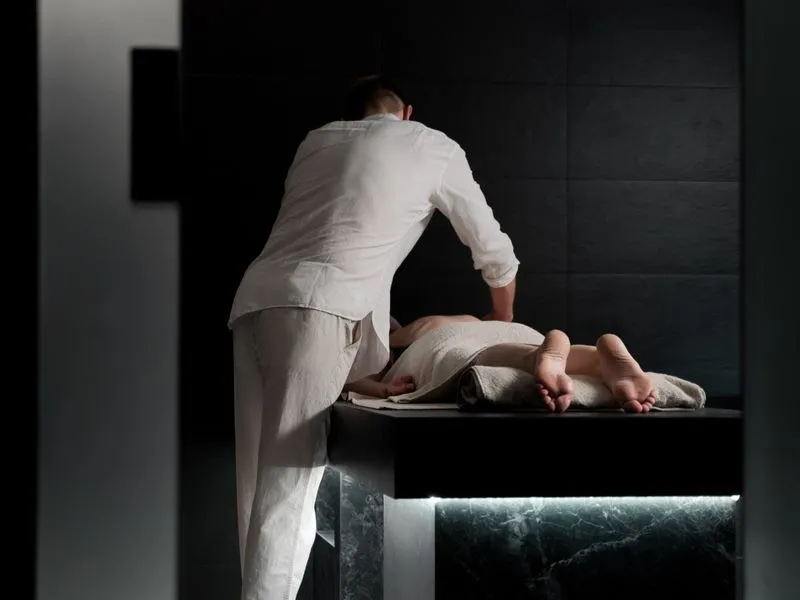
If you are comparing deep tissue with trigger point massage in Dubai, the practical distinction is breadth: deep tissue follows a wider pattern of tension with slow, deliberate contact, while trigger-point-style work gives brief, focused attention to a smaller tender spot. They can share a session, but focused pressure is a technique I may use—not a separate service—and pain is never the target.
What is the practical difference?
Deep tissue is usually the better description when your discomfort follows a broad, connected area such as the neck, shoulders and upper back. Trigger point work is a narrower description: pressure is directed at one small area that feels unusually tender, then adjusted according to your response. Neither label means “the hardest massage possible”.
| Question | Broad deep tissue | Focused trigger-point-style work |
|---|---|---|
| Scope | A region or linked pattern of tense muscle | One small tender area at a time |
| Sensation | Slow, steady pressure that builds gradually | More concentrated pressure, kept within tolerance |
| Goal | Ease a pattern of muscular tightness and support movement | Explore whether a particular spot settles with careful attention |
| Communication | We discuss the whole area, position and pressure | You tell me what changes locally or elsewhere |
| Best fit | Several connected areas, desk posture or training load | A distinct spot that is easy to locate and describe |
The word “knot” is useful everyday language, not a diagnosis. Research also uses different definitions and techniques, so evidence should be read cautiously; a review indexed on PubMed found meaningful variation in the available studies. I can offer a sensible massage approach, but I cannot promise a particular result or identify the cause of a symptom from a message alone.

If you want a fuller explanation of the focused approach, my guide to what trigger point therapy means gives more background. If you are ready to discuss a booking, my deep tissue massage service in Dubai explains the session in plain terms.
When does broad deep tissue make more sense?
Broad deep tissue makes more sense when tension is spread across linked muscles rather than sitting in one clearly defined spot. A long day at a laptop may leave the chest, shoulders, neck and upper back working together differently; a week of training may affect the legs, hips and lower back as a connected pattern. Working gradually across that area lets us notice what is actually sensitive.
I begin with a conversation about what you feel, when it appears and which positions change it. Then I use slow layers of pressure, checking in rather than assuming that more force is more useful. The aim is to support comfortable movement and ease ordinary muscular tension, not to overpower your body. You should be able to breathe normally and answer me throughout.
Deep does not mean bruising, holding your breath or tolerating sharp pain. A useful pressure can feel strong, broad or “good tired”, but it should not feel electric, burning, numb or like pain travelling down an arm or leg. If a broad area is severely painful, newly swollen, hot, weak or changing quickly, massage is not the first step; arrange medical assessment instead.
For people who sit for long periods, travel frequently or train regularly, a broad session may also leave time to address how several areas relate. My sports & recovery massage is another option when your main context is running, padel, gym work or preparation around training.
When can focused pressure be useful?
Focused pressure can be useful when you can point to a small, distinct tender area and the sensation behaves like local muscular tension. I may spend a short period there, reduce or change the pressure, and then reassess the surrounding movement. It is a conversation with the tissue, not a test of endurance and not a claim that one spot is the source of every problem.
Some people describe a familiar ache in a nearby area when a tender spot is pressed. I treat that report cautiously and stop if the sensation becomes sharp, electric, numb or travels in a worrying way. A focused technique cannot tell us whether pain comes from a nerve, joint, disc, injury or another condition. The Cleveland Clinic overview of myofascial pain syndrome is a useful reminder that persistent pain and tender points may need proper medical assessment.
Trigger point therapy is not one of my six bookable services. My menu is Deep tissue; Swedish & relaxation; Sports & recovery; Prenatal & postnatal; Lymphatic drainage; and Aromatherapy. When it is appropriate, focused pressure may be included inside a deep tissue or sports & recovery appointment. I do not present it as a clinical treatment, and I do not diagnose or promise to resolve a condition.
If you are unsure, message me on WhatsApp with the exact area, what the sensation feels like and whether it changes with movement. I can tell you honestly whether a professional massage session sounds suitable. You can also read my guide to massage for muscle knots in Dubai before deciding.
Can both approaches share one session?
Yes, broad work and brief focused pressure can share one responsive session when your symptoms and comfort make that sensible. We might begin with the larger pattern, notice one particularly tender spot, spend limited time there, and return to broader work. The balance is adjusted during the appointment rather than fixed by a label.
Appointments are available for 60, 90 or 120 minutes at the same hourly rate. A home visit is AED 400 per hour; a studio appointment is AED 300 per hour. There is no deposit. Payment is cash, with bank transfer on request. For a clear breakdown, see massage pricing in Dubai.
I am Mei Han, an independent female massage therapist. I welcome both women and men, and every appointment is strictly professional, by appointment and conducted with proper draping. You choose the pressure, and you can ask me to pause, change an area or stop at any time. I visit homes, hotels and serviced apartments across Dubai, including DIFC, or you can come to my studio.
When is massage the wrong next step?
Massage is the wrong next step when symptoms suggest that you need assessment before hands-on work. Please speak with a doctor or physiotherapist first if discomfort is persistent, severe, worsening or follows a significant injury, especially with weakness, numbness, radiating pain, loss of coordination, fever, unexplained swelling or changes in bladder or bowel control.
Do not delay medical care because a massage temporarily changes a sensation. The NCCIH information on massage therapy also advises people to consider risks and not use massage to postpone necessary healthcare. If you are pregnant, recently operated on or managing a diagnosed condition, ask your doctor or midwife what is appropriate before booking.
If there are no red flags and your concern sounds like ordinary muscular tightness, we can keep the session measured and transparent. I will work within your comfort, use proper draping and maintain a strictly professional setting; I will not force a painful spot simply because it has been called a trigger point.
If you would like to compare your options with me, send a WhatsApp message to Mei on WhatsApp: “Hi Mei, I’m choosing between broad deep-tissue work and focused pressure. My main area feels:”. Tell me where you are in Dubai, whether you prefer a home visit or studio, and which duration—60, 90 or 120 minutes—you have in mind. I am available daily 10:00–23:00 by appointment, often for same-day bookings.
Frequently asked questions
What is the difference between deep tissue and trigger point massage?
Deep tissue usually works slowly across a broader pattern of muscular tension, while trigger-point-style work focuses pressure on a smaller tender spot and checks how the surrounding area responds. They are not opposites and can be blended. I offer deep tissue as a service; trigger point work is not a separate menu item.
Is trigger point massage the same as deep tissue massage?
No. Trigger point work describes a focused technique, not simply heavy pressure. Deep tissue describes a wider session approach using slow, deliberate work through tense muscle areas. Either should stay within your tolerance; sharp, electric, numb or travelling pain is a reason to stop and seek assessment.
Which is better for muscle knots?
A small, distinct tender point may suit brief focused pressure, while several linked tight areas may suit broader deep-tissue work. A so-called knot is not a diagnosis, and pressure should not be forced. Persistent, severe or worsening symptoms—especially weakness, numbness or radiating pain—need a doctor or physiotherapist.
Can I book trigger point therapy in Dubai with Mei?
Trigger point therapy is not one of my six standalone services. When appropriate, I may use focused pressure within a deep tissue or sports & recovery appointment. Message me on WhatsApp with the location and behaviour of the discomfort so I can explain whether my service is a sensible fit.
How much is deep tissue massage in Dubai?
Deep tissue costs AED 400 per hour for a home visit and AED 300 per hour at the studio. The same hourly rate applies to 60, 90 and 120 minutes, with no deposit. Payment is cash, and bank transfer is available on request. Appointments are strictly professional and by appointment.