By Mei Han, massage therapist in Dubai Updated 17 October 2026
Short answer
Postpone massage during active spinning or unexplained dizziness. For a diagnosed, settled condition, check medical advice and map the positions and movements you tolerate before booking.
In Dubai and want hands-on help? Message Mei on WhatsApp · female therapist, AED 400/hr at home, no deposit.
Postpone a routine massage while you have active spinning or unexplained dizziness. If a diagnosed condition is settled, check the medical advice you have been given and describe the movements that trigger symptoms before booking. I’m Mei, an independent female massage therapist in Dubai; a suitable appointment needs comfortable positions and transitions, not a trial of whether you can endure them.
Should you book during an episode of vertigo?
Choose care and recovery first during an active episode, rather than booking massage to stop the spinning. A new or recurring problem needs a clinician’s assessment, especially if it affects your balance or everyday activities. Once the condition has been assessed, we can discuss a future massage for relaxation without treating it as vertigo care.
Vertigo describes a sensation that you or your surroundings are spinning. It is not a diagnosis of the cause, and it is not interchangeable with every lightheaded feeling. Saying exactly what happens gives your clinician useful information; telling a massage therapist “I get dizzy sometimes” leaves the practical trigger unclear.
The NHS vertigo guidance recommends medical review for persistent or recurrent symptoms. Vertigo with new double vision or vision loss, hearing loss, difficulty speaking, or limb weakness or numbness needs emergency assessment. Severe headache, marked sickness or fever also needs urgent medical advice; do not wait for a massage reply.
If your clinician has already explained a familiar condition, follow that plan when symptoms recur. A previous diagnosis should not be used to dismiss symptoms that are new, different or more severe. The appointment can wait while you establish what is happening.
For a future booking, separate two questions: “Is massage appropriate within my care?” and “Can this particular session be arranged comfortably?” The first belongs with your clinician. I can help answer the second once we know the actual positions, movement limits and support you need.
Why can lying down or turning matter?
Some causes of vertigo are sensitive to changes in head position, so a massage can involve relevant movements even when no head or neck work is planned. Lying back, rolling to the other side and sitting up are all part of an ordinary appointment. Choosing shoulder work does not automatically remove those transitions.
Johns Hopkins Medicine explains BPPV as an inner-ear condition in which changes in head position can provoke spinning. It describes diagnosis and repositioning treatment as clinical procedures. I do not diagnose BPPV, perform an Epley manoeuvre or use massage as a way to reposition inner-ear crystals.
Your clinician may identify a different cause altogether. Do not copy positioning advice from another person’s BPPV experience or assume all vertigo has the same solution. Bring the instructions that apply to you, particularly after recent assessment or treatment.
Make a movement map from situations you already know, without deliberately provoking symptoms:
| Part of the appointment | Useful information to send |
|---|---|
| Settling onto the bed | Whether lowering your head or lying back is a known trigger |
| Resting in one position | Which positions are already comfortable and any clinical restrictions |
| Turning | Whether one direction or a change in head angle causes trouble |
| Sitting and standing afterwards | Whether you need pauses or support already arranged in your daily routine |
Joint instability raises a different set of questions about support and movement range. If that is also relevant, the hypermobility and massage guide addresses it separately. Comfortable joints do not prove a position is acceptable for your balance symptoms, or vice versa.
How do you plan a session without testing your limits?
Build the session around positions you already tolerate and any restrictions from your clinician. Do not book a standard full-body sequence and hope the difficult parts will be manageable on the day. A smaller agreed scope can be more useful than repeatedly changing position to reach every area.
Tell me what you actually want: perhaps general relaxation or comfortable work on the arms and shoulders. Then explain which positions are possible. If those two things cannot be combined with the usual setup, postponing or choosing another appropriate provider is more sensible than inventing an arrangement neither of us has assessed.
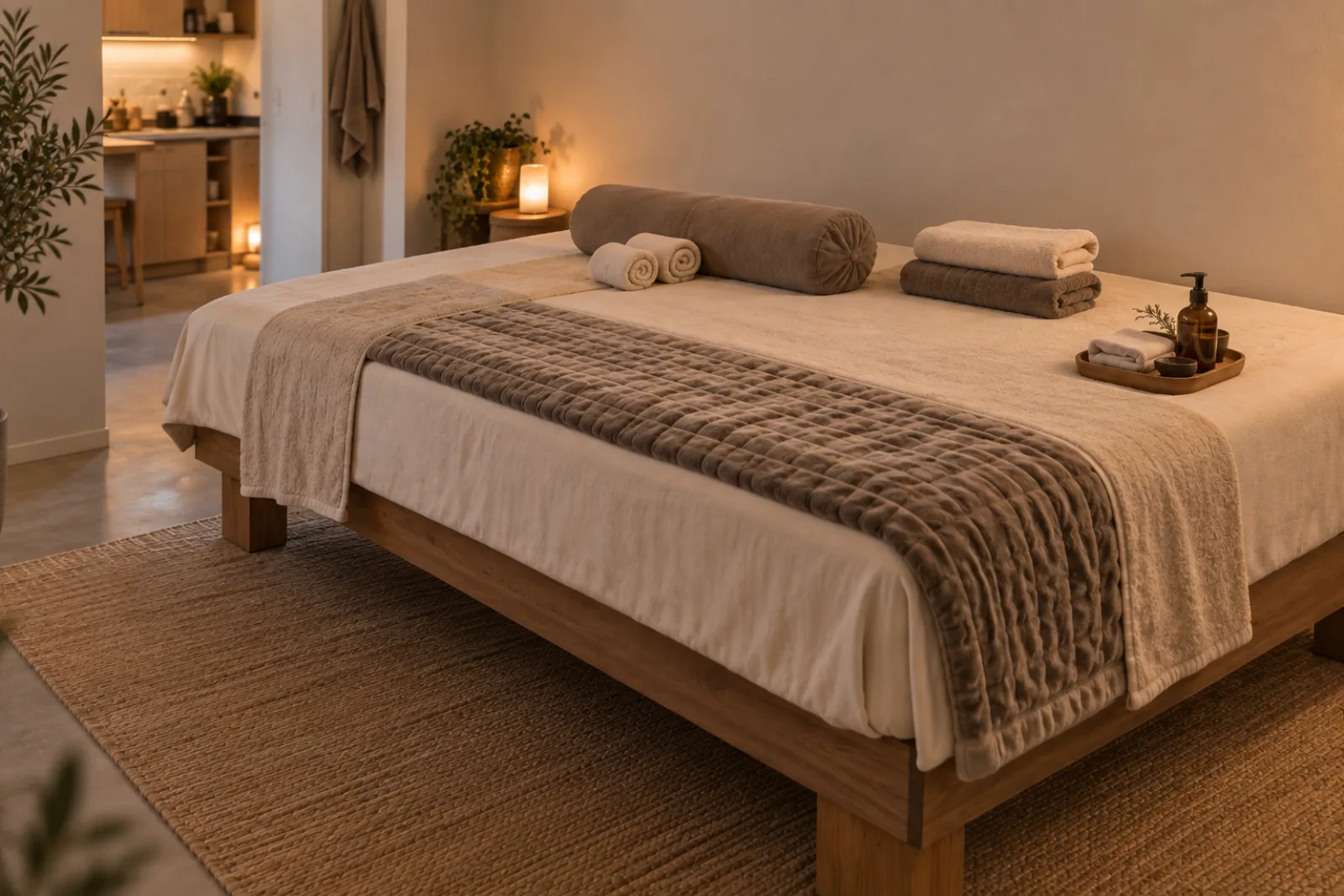
For home visits, I use a massage blanket on your own bed with fresh linens, a headrest and a bolster. The studio uses a large client bed. The home and studio setup guide shows the ordinary arrangement; it should not be assumed to include adjustable clinical equipment, lifting assistance or vestibular rehabilitation support.
Agree how changes will be announced. “Please tell me before I turn, and let me decide when I am ready” is a useful instruction. We can also agree to pause between stages, but moving slowly is not a guarantee that a known trigger will disappear.
Consider the room around the session. Tell me if you need a stable visual point, prefer the light left on or find a particular environment uncomfortable, following advice you already use. A dim room is not automatically the right room for everyone. Your preferences should be specific enough to check before arrival.
Send your movement and positioning notes on WhatsApp. Include any practical help you normally need and whether it is available. A home visit removes travel to a studio; it does not replace personal assistance or clinical supervision when those are required.
What should happen if dizziness starts?
Tell me immediately, stop the massage and avoid rushing into another position. Follow the plan your clinician has given you and seek medical help when symptoms call for it. Continuing the routine to see whether it settles is not the purpose of the appointment.
The stop phrase can be simple: “I feel spinning; please stop.” You do not need to identify the cause or apologise for interrupting. We should not assume the sensation is normal relaxation, a release of tension or something you are expected to work through.
Once symptoms have started, do not experiment with repeated rolling, strong neck pressure or a manoeuvre copied from a video. That turns a relaxation visit into an unassessed treatment attempt. A manoeuvre prescribed and taught by your own clinician belongs within their care instructions, not something added by me during massage.
Do not stand or walk until it is safe to do so, and do not drive while dizzy. If the symptoms are new, severe or accompanied by the warning signs above, obtain appropriate urgent help. Neither the number of minutes left nor the fact that you are in your own home changes that priority.
For later planning, note which stage preceded the symptoms: settling down, a turn, a head movement or getting up. Share that information with your clinician when needed. It can also tell us that the original booking arrangement should not simply be repeated, without claiming the massage caused or identified the underlying problem.
If you have persistent or severe neck pain, numbness or radiating pain, see your doctor or a physiotherapist before hands-on work. Neck discomfort and dizziness occurring together should not be reduced to a muscle-knot explanation. Massage is supportive care for appropriate comfort goals, not a diagnostic test.
How do you choose a suitable appointment in Dubai?
Choose the appointment after the medical and movement questions are resolved. Swedish and relaxation massage may fit a gentle comfort goal when the agreed positions are practical. A stronger service is not a treatment upgrade for vertigo, and a longer session is not necessarily a better first choice.
Discuss the scope before deciding between 60, 90 and 120 minutes. If the useful work fits comfortably into the shortest offered session, there is no need to commit to more time merely to complete a conventional routine. Conversely, do not assume a short appointment is suitable when the required positions still trigger symptoms.
Home and hotel visits cost AED 400 per hour; studio visits cost AED 300 per hour. The same hourly rate applies to all three durations, with no deposit and cash payment or bank transfer on request. The massage prices are separate from any medical care you may need before booking.
I welcome both women and men, daily 10:00–23:00, by appointment, for strictly professional massage with proper draping. Tell me your Dubai area, the comfort goal and the practical limits together. This gives us a clear starting point rather than asking you to fit a standard sequence.
Message me with your assessed condition and appointment preferences. We can confirm what is feasible once symptoms and medical advice allow, keeping the aim a comfortable massage rather than a test of your balance.
Frequently asked questions
Can massage treat BPPV or move the ear crystals?
My massage service does not diagnose or treat BPPV, and I do not perform repositioning manoeuvres. Seek assessment and treatment from an appropriate clinician. Once your condition is assessed and a relaxation appointment is suitable, message me on WhatsApp with the positions you tolerate and any restrictions you have been given.
Can I have a massage if lying down makes me dizzy?
Do not book a standard lying-down routine and hope the trigger will disappear. Get medical advice about new or recurring dizziness, then check whether a useful massage can fit positions you already tolerate. Send the movement restrictions on WhatsApp before booking; I cannot promise specialised positioning equipment or clinical supervision.
What if I feel spinning when I turn during massage?
Tell me immediately so the massage stops, and avoid rushing into another position. Follow your existing medical plan and seek urgent help for new, severe or concerning symptoms. Do not drive while dizzy. For a later appointment, message me on WhatsApp with any updated advice rather than repeating the same arrangement automatically.
How much is a suitable relaxation massage in Dubai?
Home and hotel appointments are AED 400 per hour; studio appointments are AED 300 per hour. Choose 60, 90 or 120 minutes at the same hourly rate, with no deposit and cash payment or bank transfer on request. Medical suitability and a workable movement plan should be established before confirming the booking.