Self-care · Neck
How to massage a stiff neck by yourself: 3 gentle moves you can do at your desk
Updated 11 October 2026
Short answer
Use your fingertips on the base of your skull, knead the top of each shoulder, then do a slow ear-to-shoulder stretch — about two minutes, gentle pressure only. Don't crack, jerk or press hard on the front or sides of your throat. If the stiffness followed a fall, or comes with numbness, fever or a severe headache, see a doctor.
In Dubai and want hands-on help? Message Mei on WhatsApp · female therapist, AED 400/hr at home, no deposit.
I’m Mei, an independent female massage therapist in Dubai. This is the routine I’d suggest for a neck that’s stiff from sleep or screens. It’s gentle on purpose: pressing hard on a guarding muscle only makes it guard more.
How do you massage a stiff neck by yourself?
Work three spots in order: the base of your skull, the top of each shoulder, then a slow side stretch. Use gentle pressure, around three or four out of ten, and nothing sharp. The whole routine takes about two minutes sitting at your desk, and you can repeat it two or three times a day.
Move 1: loosen the base of your skull (30–45 seconds)
These small muscles tighten when your head drifts forward towards a screen.
- Sitting tall, place your fingertips in the soft hollows just below the bony ridge at the back of your skull, one hand either side of the spine.
- Press in gently and make small, slow circles for 30–45 seconds.
- Keep the light pressure and slowly nod “yes” three or four times.
Move 2: knead the top of your shoulders (8–10 squeezes per side)
This ridge of muscle creeps up towards your ears when you’re stressed or typing.
- Reach across with your right hand to the top of your left shoulder.
- Squeeze slowly, hold for a breath and release, 8–10 times, working outwards from the neck to the shoulder tip.
- Let the shoulder drop as you breathe out, then switch sides.
Move 3: a slow ear-to-shoulder stretch (20–30 seconds per side)
- Sit tall and let your right ear drop towards your right shoulder until you feel a comfortable stretch down the left side of your neck.
- To deepen it slightly, hold the edge of your chair with your left hand. Don’t pull your head with your other hand.
- Hold for 20–30 seconds, breathing slowly, then come up gently and switch sides.
- If it’s very stiff, do shorter holds: five seconds, three times each side.
Where are the pressure points for a stiff neck?
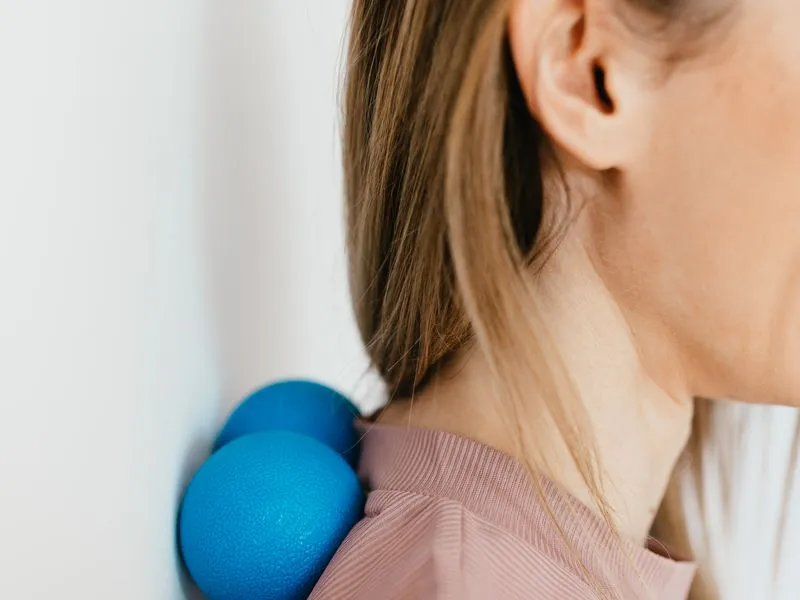
There’s no single magic point, but three muscle spots usually hold the stiffness: the base of the skull, the top of the shoulders and the area between the shoulder blades. Moves 1 and 2 cover the first two. For the third, which your own hands can’t reach well, use a wall.
Stand with your back to a wall and a tennis ball between the wall and the muscle beside your spine, never on the spine itself. Bend your knees slowly so the ball rolls a few centimetres up and down, for about 30 seconds.
What not to do with a stiff neck
Don’t crack, jerk or force it, and never press hard on the front or sides of your throat or on the bony spine. Keep the neck moving gently rather than holding it rigid, and stop any move that sends a sharp or electric feeling down your arm.
The NHS advice on neck pain adds three more:
- No neck collar unless a doctor has told you to wear one; it’s better to keep moving.
- No driving or cycling if you can’t turn your head properly.
- No sleeping on your front, and no twisting your neck in bed.
Is it good to massage a stiff neck?
Yes, gently, when it’s ordinary muscle stiffness from sleeping awkwardly or hours at a screen. Light pressure and slow movement help the muscles stop guarding. Warmth first helps: the NHS suggests a hot water bottle wrapped in a tea towel for up to 20 minutes, two or three times a day.
Expect relief rather than a reset. The US National Center for Complementary and Integrative Health notes that massage may help neck pain, but the benefit may be short-lived, so the habits below matter as much as the moves.
When does a stiff neck need a doctor?
See a doctor urgently if the stiffness started after a fall or accident, or comes with a fever and a severe headache. See a GP if it hasn’t gone after a few weeks, if painkillers haven’t helped, or if you have pins and needles, numbness, weakness or a cold arm. Don’t self-massage in any of these cases.
How do you stop a stiff neck coming back?
Change the positions that cause it. The NHS lists long hours at a desk and sleeping with your neck at an awkward angle among the most common causes of neck pain, so screen height, regular breaks and the right pillow do more for next week than any massage.
- Raise your screen so the top sits at eye level, and lift your phone to your eyes.
- Move every 30–45 minutes: roll your shoulders and look away from the screen.
- Use a low, firm pillow that keeps your head level with your body.
- Do the three moves at the end of a long desk day, not only when it hurts.
If you keep waking up stuck, read massage for a stiff neck. If it spreads into your shoulders, see massage for neck and shoulder pain; if it becomes a band around your head, massage for tension headaches. For tension built up over weeks, a deep tissue session at your home or hotel reaches what your fingertips can’t.
Frequently asked questions
What not to do with a stiff neck?
Don't crack it, jerk it or roll your head in fast circles, and don't press hard on the front or sides of your throat or on the bony spine. Don't wear a neck collar unless a doctor tells you to, and don't drive if you can't turn your head properly. Gentle movement and light pressure help far more than force.
Where is the pressure point for a stiff neck?
There isn't one magic point, but there are three muscle spots worth working: the soft hollows at the base of your skull, the ridge of muscle on top of each shoulder, and the area between your shoulder blades. Press gently, hold or make small circles for 30 seconds, and stop if anything feels sharp, tingly or numb.
Is it good to massage a stiff neck?
Yes, gently, when it's ordinary muscle stiffness from sleeping awkwardly or long screen time. Light pressure and slow movement help the muscles stop guarding. The exceptions: if the stiffness followed a fall or accident, comes with numbness or weakness in an arm, or arrives with fever and a severe headache, don't massage it. See a doctor first.
How long does a stiff neck last?
A neck that stiffened from sleeping awkwardly often starts to ease within a few days, especially if you keep it moving gently. The NHS says most neck pain lasts only a few weeks. See a GP if it hasn't gone after a few weeks, if painkillers haven't helped, or if you notice pins and needles or a cold arm.
Want it sorted properly?
A deep tissue session releases what stretching can't reach — at your home or my studio in Dubai.
Book on WhatsApp
Home & hotel massage across Dubai